Home  /  Research  /  Job Market Paper
Job Market Paper · draft available on request

Approval Without Amplification

Gender and visibility on algorithmically mediated platforms  ·  Katie Apker, Cornell ILR

The finding in 30 seconds

In a random sample of 9,232 U.S. YouTube creators and more than 6 million comments, women's channels get about 33% fewer views. About a third of the raw gap is explained by production differences. Topics, titles, transcripts, and thumbnails barely move the remaining gap: no single creator-controlled surface explains more than about 9%, and some run in women's favor. Women's channels receive more positive and less profane comments, and those softer signals are less rewarded by human resharing and an inferred engagement-optimizing recommender system.

Same finding, in one line: women get approval, men get amplification.

33%
fewer views for women's channels
≈ 90%
of the remaining view gap is explained by the positivity and profanity of the comments each channel receives
9,232channels
82,000+videos
6M+audience comments analyzed
What explains it What does not The mechanism The talk The literature The paper

How Much Does Each Factor Explain?

The gap starts at 33%. Add one explanation at a time and watch how much of it is explained. Almost all of it turns out to be the negativity and profanity of the comments.

  1. The starting gap: 0% explained. Women's channels get about a third fewer views, before accounting for anything.
  2. Production → about 33% explained. Comparing channels of similar age, output, and quality explains about a third of the gap. Video output is the biggest single piece. A real 22% gap remains.
  3. Topic & their own content → about 42% explained. Content categories plus how women title and frame their own videos add only a little beyond production, about nine more points. It is not what women are making or how they present it.
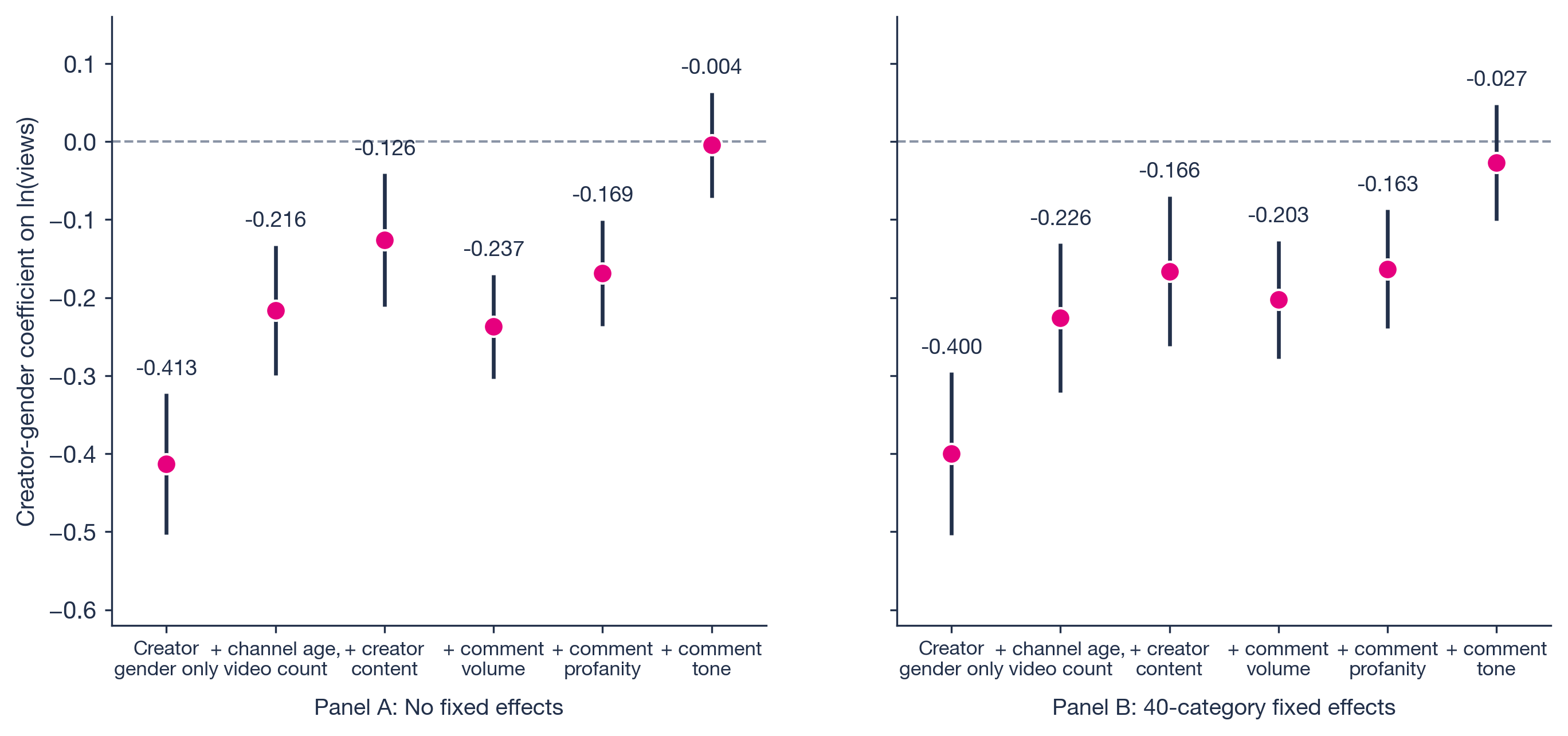
  4. The comments they get → ≈ 100% explained. Account for how negative and how profane each channel's comments are, and the gap is no longer distinguishable from zero. Comment treatment accounts for approximately 90% of the remaining gap. Women get more positive and less profane comments; men get more high-arousal comments, and amplification rewards those signals.

Ten Explanations I Tested and Ruled Out

The obvious answers were the first ones I checked. Open any one to see the test and the result.

Topic
Do women just pick lower-traffic topics?
No, within the same categories, women still get about 20% fewer views.
Comparing only within the same 40 content categories removes just ~11% of the gap. Nearly 9 in 10 of it is within-category.
Output
Do women post fewer videos?
Partly, but a 22% gap remains after holding it constant.
Video count is the single largest ordinary factor in the raw gap. Hold it and the other basics constant and about 22% fewer views still remains.
Titles & descriptions
Is it how women title their own videos?
No, their own word choices move the gap by under 3%.
Scoring every title and description and holding them constant removes only a few percent of the gap.
Transcripts
Is it what women actually say in their videos?
No, spoken content runs in women's favor: holding it constant leaves the gap intact, even slightly larger.
Transcript language, scored with the same tools as everything else, explains essentially none of the gap. Transcript availability is equal across genders (about 88% for both), so it is not a data artifact.
Thumbnails
Is it how women package their videos?
No, women's thumbnails are if anything an asset: more positive, warmer, less clickbait.
Packaging is the largest single creator-controlled surface and still explains under about 9% of the remaining gap; in the integrated model it partly runs in women's favor.
Subscribers
Do audiences subscribe to women less?
No, there is no real subscriber gap. The shortfall is only in views.
Run the same models with subscribers as the outcome and the gap essentially disappears.
Engagement
Do audiences value women's content less?
No, women's channels get higher engagement, not lower.
More likes and comments relative to audience size, on women's channels, not fewer.
Who comments
Is it just male commenters?
No, male and female commenters both soften on women's channels.
Measured separately, both groups address women's channels with warmer, lower-heat language. The pattern does not depend on who is commenting.
Self-promotion
Do women promote themselves less elsewhere?
No, women link out more, and it does not change the gap.
Women link to other platforms more often (about 20% vs 16%); accounting for it leaves the view gap intact.
Backlash
Is it backlash against women in male-typed fields?
No, the backlash test comes back null.
The three-way interaction is not statistically significant (beta=0.026, p=.73), so the visibility penalty attaches to the affective signal itself, not specifically to women as a category.

It also holds up under the usual robustness checks: outliers, missing data, comment length, alternative codings, and alternative ways of computing the statistics.

Amplification Rewards High-Arousal Signals

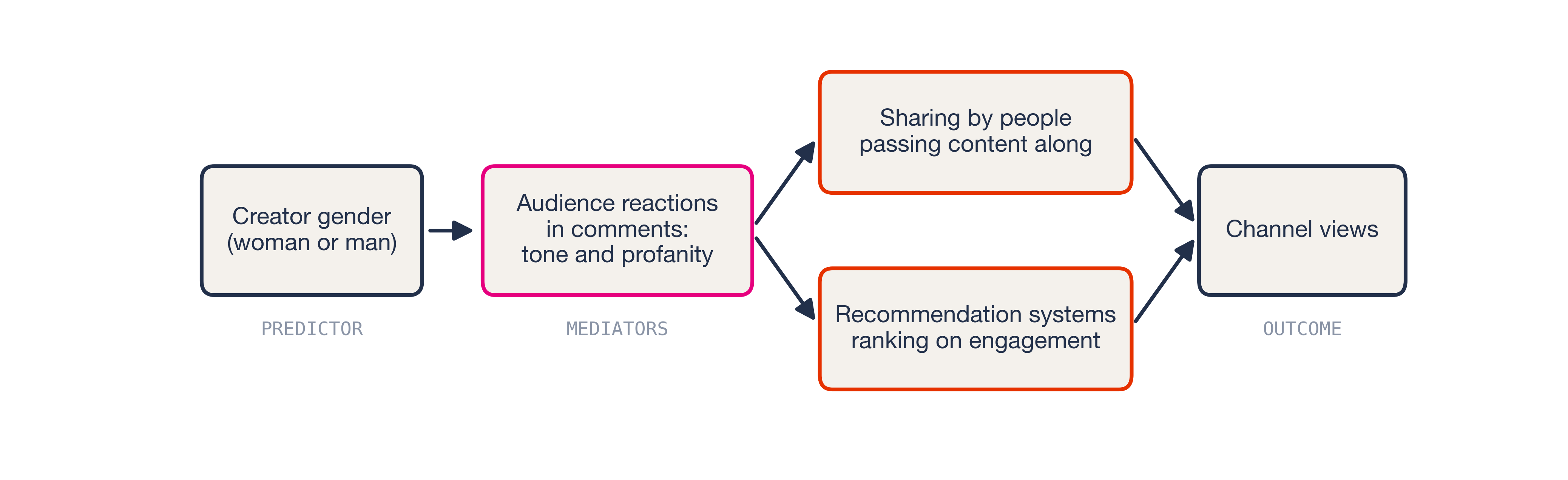
Both human resharing and an inferred engagement-optimizing recommender system reward high-arousal signals. In the models, positive comment tone is associated with fewer views (about -0.43), while profanity is associated with more views (about +0.20). Because women's channels receive more positive and less profane comments, softer treatment becomes lower visibility.

Women's channels

  • Warmer, more positive comments
  • About half as much profanity
  • Calmer, lower-heat engagement
→ weaker amplification, fewer views

Men's channels

  • More contentious comments
  • More profanity
  • Hotter, higher-arousal engagement
→ stronger amplification, more views
Creator gender shapes the positivity and profanity of audience comments, which recommendation and resharing amplify into visibility.
How warmer treatment becomes fewer views: gendered comment patterns, amplified by recommendation and resharing.

Talk Overview

A short version of the job market paper argument: on YouTube, audience reception and visibility are linked by recommendation systems rather than by a single evaluator who also allocates resources. Gender-and-entrepreneurship research often explains women's disadvantage through unfavorable evaluation; I ask whether that account holds when platform amplification sits between evaluation and allocation. Studying a random sample of 9,232 U.S. creators and more than 6 million audience comments, I find that women's channels receive about 22% fewer views after controls even though audiences treat them more favorably. Warmer reception is associated with less amplification and high-arousal engagement with more, so favorable treatment can coexist with lower visibility.

As presented: the research camp slides

The actual deck from my Cornell M&O Research Camp talk (May 2026). Click a slide or use the buttons to advance.

Research camp slide 1 of 32 Research camp slide 2 of 32 Research camp slide 3 of 32 Research camp slide 4 of 32 Research camp slide 5 of 32 Research camp slide 6 of 32 Research camp slide 7 of 32 Research camp slide 8 of 32 Research camp slide 9 of 32 Research camp slide 10 of 32 Research camp slide 11 of 32 Research camp slide 12 of 32 Research camp slide 13 of 32 Research camp slide 14 of 32 Research camp slide 15 of 32 Research camp slide 16 of 32 Research camp slide 17 of 32 Research camp slide 18 of 32 Research camp slide 19 of 32 Research camp slide 20 of 32 Research camp slide 21 of 32 Research camp slide 22 of 32 Research camp slide 23 of 32 Research camp slide 24 of 32 Research camp slide 25 of 32 Research camp slide 26 of 32 Research camp slide 27 of 32 Research camp slide 28 of 32 Research camp slide 29 of 32 Research camp slide 30 of 32 Research camp slide 31 of 32 Research camp slide 32 of 32

What This Builds On

The finding rests on three established literatures: how attention spreads online, how ranking systems amplify without any gendered intent, and how favorable-seeming treatment can still be biased.

Why intensity spreads and warmth does not

  • Berger & Milkman (2012), Journal of Marketing Research
  • Brady et al. (2017), PNAS
  • Rathje et al. (2021), PNAS
  • Milli et al. (2025), PNAS Nexus

How ranking amplifies, without gendered intent

  • Huszar et al. (2022), PNAS
  • Lambrecht & Tucker (2019), Management Science
  • Covington et al. (2016), ACM RecSys

Softer treatment as a form of bias

  • Glick & Fiske (2001), American Psychologist
  • Bareket & Fiske (2023), Psychological Bulletin
  • Nguyen et al. (2024), Entrepreneurship Theory & Practice

The evaluation-gap tradition it revises

  • Kanze et al. (2018), Academy of Management Journal
  • Brooks et al. (2014), PNAS
  • Ewens & Townsend (2020), Journal of Financial Economics

Full references are in the manuscript.

Read It in Full

The full manuscript is available on request. The headline findings: women's channels receive about 22% fewer views than comparable men's after controls, yet earn higher engagement and have no statistically significant controlled subscriber gap; topics, titles, transcripts, thumbnails, and other creator-controlled surfaces barely move the gap, with no single surface explaining more than about 9%; women receive more positive and less profane comments while men receive more high-arousal comments; and once audience comment treatment enters the model, the remaining gap is not distinguishable from zero. I call the mechanism a negative arousal bonus: human resharing and an inferred engagement-optimizing recommender system amplify high-arousal engagement into visibility more powerfully than positive reception. When algorithmic intermediaries stand between evaluation and allocation, positive reception can lose its protective force.

The gender gap in views shrinks to statistical non-significance as audience comment positivity and profanity enter the model.
The gap shrinks to non-significance as the positivity and profanity of comments enter the model.

Cite this paper

@unpublished{apker_approval_2026, author = {Apker, Katie}, title = {Approval Without Amplification: Gender and Entrepreneurial Visibility on Algorithmically Mediated Platforms}, note = {Working paper, Cornell University, ILR School}, year = {2026} }